

Fuel Oil Tank Survey aboard Ships: Types, Scope, Frequency & Regulatory Requirements
Fuel Oil Storage Tank Survey aboard Ships: Types, Scope, Frequency & Regulatory Requirements
1. Introduction: why fuel oil tank surveys matter
The fuel oil (F.O.) storage tank is one of the most critical and demanding structural components aboard any ocean-going vessel. Permanently integrated into the ship's double bottom or wing tank structure, it operates under continuous thermal cycling from the heating coils, chemical attack from residual fuel sludge and water bottoms, and structural stress from the ship's own loading and sea-state responses. Left unexamined, the internal plating, frames, stiffeners, and coating systems of these tanks can deteriorate silently — leading to structural weakness, fuel contamination, or ultimately, a catastrophic failure of tank integrity.
It is precisely for these reasons that the International Association of Classification Societies (IACS) mandates a rigorously structured, age-progressive programme of internal and external surveys for all fuel oil storage tanks aboard classed vessels. These surveys form an integral part of the vessel's classification maintenance cycle and are legally underpinned by SOLAS Chapter I, which gives classification societies the statutory authority — delegated by flag state administrations — to issue and maintain the vessel's Class Certificate.
The governing instrument for fuel oil tank survey requirements across all ship types (other than oil tankers under ESP) is IACS Unified Requirement Z7 (Rev.29, Corr.1, 2024), specifically its Table 3, which directly prescribes the type and frequency of internal examination for fuel oil, lube oil and fresh water tanks at every stage of the vessel's life. This article provides a complete, authoritative breakdown of that requirement — the survey types, their frequency, their scope, and how the requirements escalate as the vessel ages.
2. Regulatory and legislative framework
The survey requirement for fuel oil storage tanks does not stem from a single regulation. It is the product of an interlocking set of international conventions, IACS instruments, and classification society rules that together create a comprehensive and legally enforceable survey obligation.
2.1 SOLAS Chapter I — The foundational legal authority
The International Convention for the Safety of Life at Sea (SOLAS), Chapter I, establishes the overarching framework for the survey and certification of ships. Under SOLAS, flag state administrations are responsible for ensuring that ships flying their flag comply with international construction and equipment standards. In practice, flag states delegate this authority to IACS member classification societies, which act as Recognised Organisations (ROs). The Class Certificate issued by these societies is the tangible product of compliance with the survey programme — and without a valid Class Certificate, a vessel cannot trade commercially, obtain P&I insurance, or satisfy port state control inspection.1
2.2 IMO Harmonised System of Survey and Certification (HSSC)
The IMO Resolution A.1186(33) established the Harmonised System of Survey and Certification (HSSC), which standardises the survey cycle across different certificate types — Classification, Load Line, Safety Construction, Safety Equipment and Safety Radio — so that they fall due simultaneously. This eliminates the inefficiency of multiple separate survey windows and forms the structural backbone of the 5-year periodical survey cycle within which fuel oil tank surveys are scheduled.2
2.3 IACS Unified Requirement Z7 (Rev.29, Corr.1, 2024) — The primary instrument
IACS UR Z7 is the definitive unified requirement that governs periodical surveys for all ship types other than oil tankers (which fall under UR Z10.1), bulk carriers (UR Z10.2), chemical tankers (UR Z10.3) and double hull tankers (UR Z10.4). It is applied uniformly by all twelve IACS member societies — Lloyd's Register, DNV, Bureau Veritas, ClassNK, ABS, RINA, KR, CCS, IRS, and others — ensuring that a vessel's survey obligations are the same regardless of which society holds its class.3
2.4 IACS UR Z1 — Annual and intermediate survey coverage
IACS UR Z1 governs the annual and intermediate classification survey requirements, aligned to IMO Resolution A.1186(33). It defines what items are to be examined at each annual survey, and what additional scope is added at the intermediate survey (which falls between the 2nd and 3rd annual survey). For fuel oil tanks, UR Z1 principally requires an external examination of tank boundaries at annual survey, with internal examination triggered only by the findings of that external check.4
2.5 Additional instruments
The IACS Procedural Requirement PR37 (Rev.3, August 2023) governs the safety conditions for the surveyor to enter the tank — gas freeing, atmosphere testing, standby arrangements, and PPE. It has been mandatory across all IACS member societies since 30 June 2013. IACS Recommendation 72 (3rd Edition, 2025) provides the detailed best-practice guidance on confined space entry procedures, atmosphere testing, permit-to-work, and PPE selection. The ISM Code, made mandatory under SOLAS Chapter IX, requires the company to embed tank entry and survey procedures within the vessel's Safety Management System (SMS).5,6
Table 1 — Regulatory instruments governing F.O. tank surveys
| Instrument | Issuing body | What it governs for FO tank surveys | Status |
|---|---|---|---|
| SOLAS Chapter I | IMO | Foundational survey and certification obligation; delegates authority to classification societies | Mandatory |
| IMO HSSC — Res. A.1186(33) | IMO | Harmonised 5-year survey cycle within which tank surveys are scheduled | Mandatory |
| IACS UR Z7 (Rev.29 Corr.1, 2024) | IACS | Primary rule — prescribes type, frequency and scope of FO tank internal surveys in Table 3 | Mandatory (class) |
| IACS UR Z1 | IACS | Annual and intermediate survey coverage for FO tank external examination | Mandatory (class) |
| IACS PR37 (Rev.3, Aug 2023) | IACS | Safety requirements for surveyor confined space entry — atmosphere, standby, PPE | Mandatory (class) |
| IACS Rec. 72 (3rd Ed. 2025) | IACS | Best practice for confined space entry, PTW, atmosphere testing, PPE selection | Guidance |
| ISM Code (SOLAS Ch. IX) | IMO | Requires SMS procedures for tank entry as a key shipboard safety operation | Mandatory |
| IMO MSC.581(110) | IMO | Current recommendations for enclosed space entry aboard ships (Dec 2025) | Guidance |
3. Types of surveys and their frequency
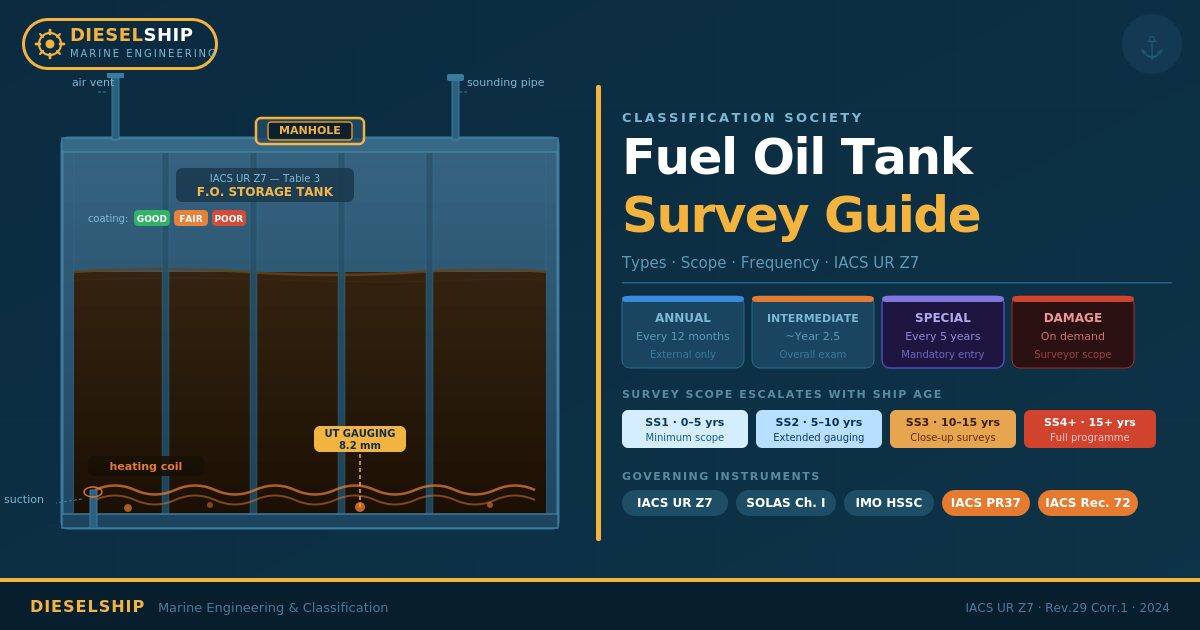
The classification survey programme for a fuel oil storage tank consists of four distinct survey types, each occurring at defined points in the 5-year survey cycle. The cycle itself repeats throughout the vessel's life, with each completed cycle constituting one Special Survey (SS1, SS2, SS3, SS4 and so on). The requirements at each Special Survey become progressively more demanding as the vessel ages.
Annual survey
Every 12 months (within a 3-month window either side of the anniversary date). External examination of tank boundaries. No mandatory internal entry.
Intermediate survey
Between the 2nd and 3rd annual survey (approximately year 2.5). Extended overall examination. Internal entry triggered by findings.
Special survey
Every 5 years (SS1, SS2, SS3...). Mandatory full internal examination, structural survey, coating assessment, thickness gauging, tank testing.
Damage / repair survey
On demand — any time damage, structural defect or leakage is identified. Scope set by the attending surveyor.
3.1 Annual survey — external examination, every 12 months
The annual survey is the lightest touch in the programme. For fuel oil storage tanks, the attending surveyor carries out an external examination of all tank boundaries — the visible plating, frames, and connections inspected from the machinery space or surrounding compartments. The surveyor is looking for signs of structural deformation, cracking, corrosion evident from the outside, leakage traces, deterioration of the manhole coaming, and the condition of vent and sounding arrangements.3
No internal entry into the tank is required at annual survey as a matter of routine. However, if the external examination reveals suspect areas — visible wastage, deformation, leakage staining, or areas of concern flagged from the previous survey — the surveyor may order an internal examination to be carried out before the annual survey is credited as complete. Thickness measurements may also be required if the external condition warrants it.
3.2 Intermediate survey — overall examination, approximately year 2.5
The intermediate survey is carried out between the 2nd and 3rd annual survey of any given 5-year cycle. It sits as a midpoint quality check between two successive special surveys. For FO storage tanks at the intermediate survey, the requirement is an overall examination — a general assessment of the structural condition of the tank, more detailed than the annual external check but not necessarily requiring the full internal entry mandated at special survey.
However, if the overall examination reveals suspect areas, or if the previous special survey identified areas of concern that require monitoring, an internal examination will be required. Similarly, where hard protective coating is found to be in a condition less than GOOD, additional examination requirements may be applied at the surveyor's discretion.
3.3 Special survey — mandatory internal examination, every 5 years
The Special Survey is the cornerstone of the classification survey programme and the point at which a full, mandatory internal examination of all fuel oil storage tanks is required under IACS UR Z7 Table 3. The special survey may be commenced at the 4th annual survey and must be completed by the 5th anniversary date — providing approximately a 15-month window for its execution.3
At special survey, the tank must be gas freed, ventilated, atmosphere tested, and fully prepared for confined space entry in accordance with PR37 and the vessel's SMS. The surveyor then carries out a detailed internal examination of the entire tank structure. Tank testing (hydraulic/pressure head test) of the tank boundaries is also mandatory at special survey.
3.4 Damage and repair survey — unscheduled, on demand
Whenever structural damage is found — through cracking, collision, grounding, excessive corrosion discovered during routine maintenance, or leakage — a damage survey is required. The attending surveyor assesses the extent of the damage, determines the scope of repair required to restore class, and verifies that the repair has been satisfactorily carried out. The scope of a damage survey is entirely at the surveyor's discretion and is driven by the nature and extent of the defect.
4. Scope of the internal examination at special survey
The internal examination carried out at special survey is a comprehensive structural and condition assessment of every accessible surface inside the tank. The attending surveyor, accompanied by the Chief Engineer or a competent ship's officer, systematically inspects all structural elements. The scope, as defined by IACS UR Z7 and the individual class society's rules, covers the following areas:
Shell plating & tank structure
- Bottom plating — pitting, grooving, general corrosion
- Side shell plating — wastage, deformation, cracking
- Tank top plating — condition and thickness
- Transverse and longitudinal frames and stiffeners
- Transverse web frames and floors
- Tank bulkheads and swash bulkheads
Protective coating assessment
- Overall coating condition graded: GOOD / FAIR / POOR
- Areas of coating breakdown, blistering, or detachment
- Extent of bare metal exposed to fuel environment
- Corrosion protection system effectiveness
- Sacrificial anode condition (if fitted)
Thickness gauging (UT measurements)
- Ultrasonic thickness measurements at suspect areas
- Comparison against as-built thickness and class minimum
- Transverse sections at locations of max. expected reduction
- Extended measurements where substantial corrosion found
- Measurement by certified UT operator, witnessed by surveyor
Connections & fittings
- Suction bell mouth and strainer condition
- Steam heating coil connections and supports
- Sounding pipe and striker plate condition
- Air pipe internal condition and float valve
- Overflow pipe connection integrity
- Manhole coaming and frame condition
Tank testing
- Hydraulic test — fill to highest point under service conditions
- Verify structural watertight integrity of all boundaries
- May be specially considered if external exam satisfactory
- Master's written confirmation of satisfactory crew-test accepted by some societies
Documentation & record
- Survey report issued listing all findings and recommendations
- Thickness measurement records retained on board
- Suspect areas recorded with sketches/photos
- Class conditions issued for any defects requiring repair
- Survey report filed with class society
5. How survey scope escalates with ship age
One of the most important and often underestimated aspects of IACS UR Z7 Table 3 is that the scope of the internal examination at each successive Special Survey becomes progressively more demanding as the vessel ages. This is not arbitrary — it reflects the well-documented fact that corrosion rates accelerate over time, coating systems degrade, and structural fatigue accumulates. A vessel at its 4th or 5th special survey presents a fundamentally different risk profile from a new ship at SS1.
5.1 Special Survey 1 (SS1) — 0 to 5 years
At the first special survey, the vessel is relatively new and the internal condition of the fuel oil tanks is generally expected to be good. The internal examination is carried out in full — all structural elements inspected, coating condition assessed — but the thickness gauging requirement is at its minimum extent. Suspect areas identified from the external examination are the primary drivers of where detailed UT measurement is taken. Tank testing is required to confirm watertight integrity of the boundaries.
5.2 Special Survey 2 (SS2) — 5 to 10 years
By the second special survey, the vessel has been in service for five to ten years. The internal examination scope remains comprehensive — all tanks examined internally — but the UT gauging programme is extended. Areas identified as suspect at SS1 must be re-examined, and thickness measurements must be taken where the external examination or the internal visual survey indicates wastage. Where substantial corrosion is found, the gauging programme is extended until the full extent of the affected area is determined.3
5.3 Special Survey 3 (SS3) — 10 to 15 years
The third special survey represents a significant step-up in survey intensity. Full internal examination of all tanks remains mandatory. The UT gauging programme is extended further — transverse sections are required at locations where the greatest reductions are suspected or revealed from deck plating measurements. Close-up surveys of all critical structural areas are mandatory. The surveyor has expanded discretion to increase the scope of inspection based on the condition of the corrosion prevention system and the structural history of the vessel.
5.4 Special Survey 4 and beyond (SS4+) — 15 years and older
From the fourth special survey onwards, the survey programme is at its most rigorous. Full internal examination of all tanks is mandatory without exception. A comprehensive thickness measurement programme is applied, with multiple transverse sections required and extended gauging of all areas showing any sign of wastage. All suspect areas from previous surveys must be re-examined. The surveyor has maximum discretion to require additional close-up surveys, staging, or access arrangements to inspect areas not otherwise accessible. Ships at this stage of their life frequently present Class Conditions — formal requirements for repair before the survey can be closed — particularly in relation to tank bottom plating, floor webs, and coating systems.
6. The coating condition trigger — an important operational catch
Beyond the standard 5-year survey cycle, IACS UR Z7 contains a critically important provision that can dramatically shorten the interval between internal examinations of a fuel oil tank. This is the coating condition trigger.
At every internal examination, the surveyor assesses the condition of the tank's internal hard protective coating and grades it as one of three categories:
GOOD
Only minor spot rusting. Coating substantially intact. No action required beyond normal maintenance. Standard 5-year survey cycle continues.
FAIR
Local breakdown, hard rust, and minor coating detachment. Bare metal exposed but not extensive. Close monitoring required. May trigger additional examination at next annual survey.
POOR
Widespread breakdown, heavy corrosion, significant bare metal. If not restored to GOOD, the tank may be required to be examined at ANNUAL intervals — overriding the 5-year cycle entirely.
7. Tank testing requirements
In addition to the visual and close-up structural examination, IACS UR Z7 requires that the boundaries of fuel oil, lube oil, and fresh water tanks are subjected to a pressure head test at each special survey. The test consists of filling the tank to the highest point that liquid will rise under normal service conditions — typically to the top of the overflow pipe — and holding it there while the surveyor examines the external boundaries of the tank for any sign of leakage, weeping, or structural distress.3
This test is the definitive proof of structural watertight integrity of the tank boundaries. It subjects the plating and all weld seams to the maximum hydrostatic pressure they will experience in service, and will reveal any pinhole corrosion, cracked welds, or failed gaskets at penetration points that may not be visible during a dry internal inspection.
8. Summary tables
Table 2 — F.O. storage tank survey types, frequency and FO tank requirement
| Survey type | Frequency | FO tank requirement | Internal entry required? | Governing standard |
|---|---|---|---|---|
| Annual survey | Every 12 months (±3-month window) | External examination of tank boundaries; check sounding, vent, manhole; examine suspect areas from previous survey | Not routinely. Required if defects found externally. | IACS UR Z7 Para. 2.1 / IACS UR Z1 / SOLAS Ch. I / HSSC |
| Intermediate survey | Between 2nd & 3rd annual survey (~Y2.5) | Overall examination of tank structure; extended check if suspect areas exist; coating condition assessment | Triggered by findings or suspect areas from previous surveys. | IACS UR Z7 Para. 2.3 / SOLAS Ch. I / HSSC |
| Special survey | Every 5 years (SS1, SS2, SS3...) | MANDATORY full internal examination; structural survey; coating assessment (GOOD/FAIR/POOR); UT thickness gauging; tank pressure head testing; close-up survey of suspect areas | Yes — mandatory at every special survey | IACS UR Z7 Para. 2.2.5 & Table 3 / SOLAS Ch. I / HSSC / PR37 / Rec. 72 |
| Damage / repair survey | On demand — any time damage or defect is identified | Internal examination of affected area; scope set by attending surveyor based on nature and extent of damage | As required by surveyor. | Class Society Rules / ISM Code / Flag State requirements |
| Coating condition trigger | Annually — if coating found POOR and not restored | Full internal examination annually until coating restored to GOOD condition | Yes — annually until condition restored | IACS UR Z7 / Class Society Rules |
Table 3 — Survey scope escalation by Special Survey number (IACS UR Z7, Table 3)
| Special survey | Ship age | Internal examination | UT thickness gauging | Close-up survey | Tank testing |
|---|---|---|---|---|---|
| SS1 | 0–5 years | All FO tanks — full internal examination | Minimum extent; suspect areas and where wastage evident | As deemed necessary by surveyor | Required — head of liquid to service level |
| SS2 | 5–10 years | All FO tanks — full internal examination | Extended; include areas identified at SS1; extended where substantial corrosion found | All suspect areas; extended by surveyor as necessary | Required — head of liquid to service level |
| SS3 | 10–15 years | All FO tanks — full internal examination | Further extended; transverse sections required at locations of maximum suspected reduction | All critical structural areas; mandatory close-up of suspect areas | Required — head of liquid to service level |
| SS4 and beyond | 15+ years | All FO tanks — full internal examination without exception | Comprehensive programme; multiple transverse sections; all areas of wastage fully measured | All critical areas; maximum surveyor discretion to extend scope | Required — head of liquid to service level |
9. Conclusion
The fuel oil storage tank survey programme is a carefully structured, age-progressive system designed to ensure the structural and environmental integrity of one of a ship's most critical compartments throughout its entire service life. The regulatory architecture is robust — SOLAS provides the legal mandate, the IMO HSSC provides the harmonised timing framework, and IACS UR Z7 provides the precise technical requirements that every IACS member society applies uniformly.
The fundamental principle at the heart of the programme is simple: mandatory internal examination every five years at special survey, with external monitoring in between at annual and intermediate surveys. What makes the programme sophisticated is its built-in mechanisms for escalation — the progressively demanding scope at SS3 and SS4+, the coating condition trigger that can reduce the internal examination interval to annually, and the surveyor's overriding discretion to extend the scope based on findings at any stage.
As vessels age beyond 15 years and enter their SS4 and SS5 cycles, the burden of compliance inevitably increases. Owners of ageing tonnage must budget proactively for the greater access arrangements, extended gauging programmes, and likely structural repairs that will be required. The alternative — a vessel that fails to maintain class due to inadequate tank condition — is a commercial and safety catastrophe that no responsible operator can afford.
References & further reading
- 1. International Maritime Organization (IMO). SOLAS — International Convention for the Safety of Life at Sea, 1974, as amended. IMO, London. https://www.imo.org
- 2. IMO Resolution A.1186(33). Harmonised System of Survey and Certification (HSSC), 2023. IMO, London, 2023.
- 3. International Association of Classification Societies. Unified Requirement Z7 — Periodical Survey of Ships Other Than those Covered by UR Z10.1, Z10.2, Z10.3, Z10.4 and Z10.5. Rev.29, Corr.1, 2024. IACS, London. https://iacs.org.uk
- 4. International Association of Classification Societies. Unified Requirement Z1 — Annual and Intermediate Classification Surveys. Rev. Sept 2024. IACS, London.
- 5. International Association of Classification Societies. Procedural Requirement PR37 — Confined Space Safe Entry. Rev.3, August 2023. IACS, London. https://iacs.org.uk
- 6. International Association of Classification Societies. Recommendation No. 72 — Confined Space Safe Practice. 3rd Edition, 2025. IACS/Witherby Publishing.
- 7. International Association of Classification Societies. Recommendation No. 84 — Guidelines for Surveys, Assessment and Repair of Hull Structure. Rev.1, 2017. IACS, London. https://iacs.org.uk
- 8. Lloyd's Register. New Survey Requirements for Bulk Carriers and Oil Tankers — alignment with IMO Res. MSC.525(106) and IACS URs Z10.1, Z10.2, Z10.4, Z10.5. LR Class News 15/24, 2024. https://www.lr.org
- 9. ClassNK. IACS Unified Requirement Z7 Rev.29 — Implementation Guidance. ClassNK, Tokyo. https://www.classnk.or.jp
- 10. IMO Resolution MSC.581(110). Revised Recommendations for Entering Enclosed Spaces Aboard Ships. Adopted 27 June 2025; entry into force 3 December 2025. IMO, London.
- 11. International Association of Classification Societies. Common Structural Rules for Bulk Carriers and Oil Tankers (CSR BC & OT). IACS, London. https://iacs.org.uk
- 12. North Standard P&I. IMO Revised Recommendations for Entering Enclosed Spaces. January 2026. https://north-standard.com
This article is an educational resource based on IACS Unified Requirements and IMO conventions current as of 2025. Always consult the current edition of IACS UR Z7 and your vessel's classification society rules for definitive survey obligations.