

Best Marine Colleges in India 2026
Best Marine Colleges in India: How to Use DGS CIP Grading Before Taking Admission
1. Introduction
Students who finish 10th or 12th and want to join the Merchant Navy usually ask the same question first: which marine college is actually good? With dozens of DGS-approved maritime institutes in India, the challenge is not just finding a college, but finding one that is strong in training quality, faculty, infrastructure, compliance, and student preparedness.
That is exactly where the Comprehensive Inspection Programme (CIP) becomes important. CIP is the official DGS quality assessment framework for Maritime Training Institutes (MTIs), and it gives students a much more reliable way to compare colleges than marketing brochures or social media claims. The current official reference point is the DGS CIP Report – July 2025, supported by the beta DG Shipping portal’s live MTI listing.
Students looking for broader maritime career guidance can also explore DieselShip and the related resource on marine careers and courses in India.
2. What is CIP?
CIP stands for Comprehensive Inspection Programme. According to the official July 2025 DGS report, maritime education and training in India are overseen by the Directorate General of Shipping under the M.S. (STCW) Rules, 2014, and CIP was introduced through DGS Order No. 25 of 2013 to regulate and enhance the standard of course delivery in maritime training institutes. The report says the evaluation framework was designed to support annual assessment and grading of each institute.
In simple words, CIP is the DGS quality-check system for marine colleges and maritime training institutes.
3. How DGS gives the grading
The DGS report says inspections are conducted through Recognized Organizations and MMDs, and the system follows a three-year cycle of Initial, Annual, and Renewal inspections. It also explains that CIP brought in a more standardized framework covering infrastructure, faculty, pedagogy, student performance, grading, and certification.
So the CIP grade is not a college’s self-declared rating. It is issued through a structured DGS-led inspection framework.
4. What are the DGS CIP grading scales?
The official grading scale in the July 2025 report is:
A1 – Outstanding
90% and above
A2 – Very Good
80% to 89.9%
B1 – Good
70% to 79.9%
B2 – Average
60% to 69.9%
C1 – Below Average
50% to 59.9%
C2 – Poor
Below 50%
For students, that means A1 and A2 are the strongest choices, B1 is acceptable but not top-tier, and B2/C1/C2 deserve more caution. This is an interpretation based on the DGS grading bands, not a separate official ranking system.
5. Latest DGS CIP report: the national picture
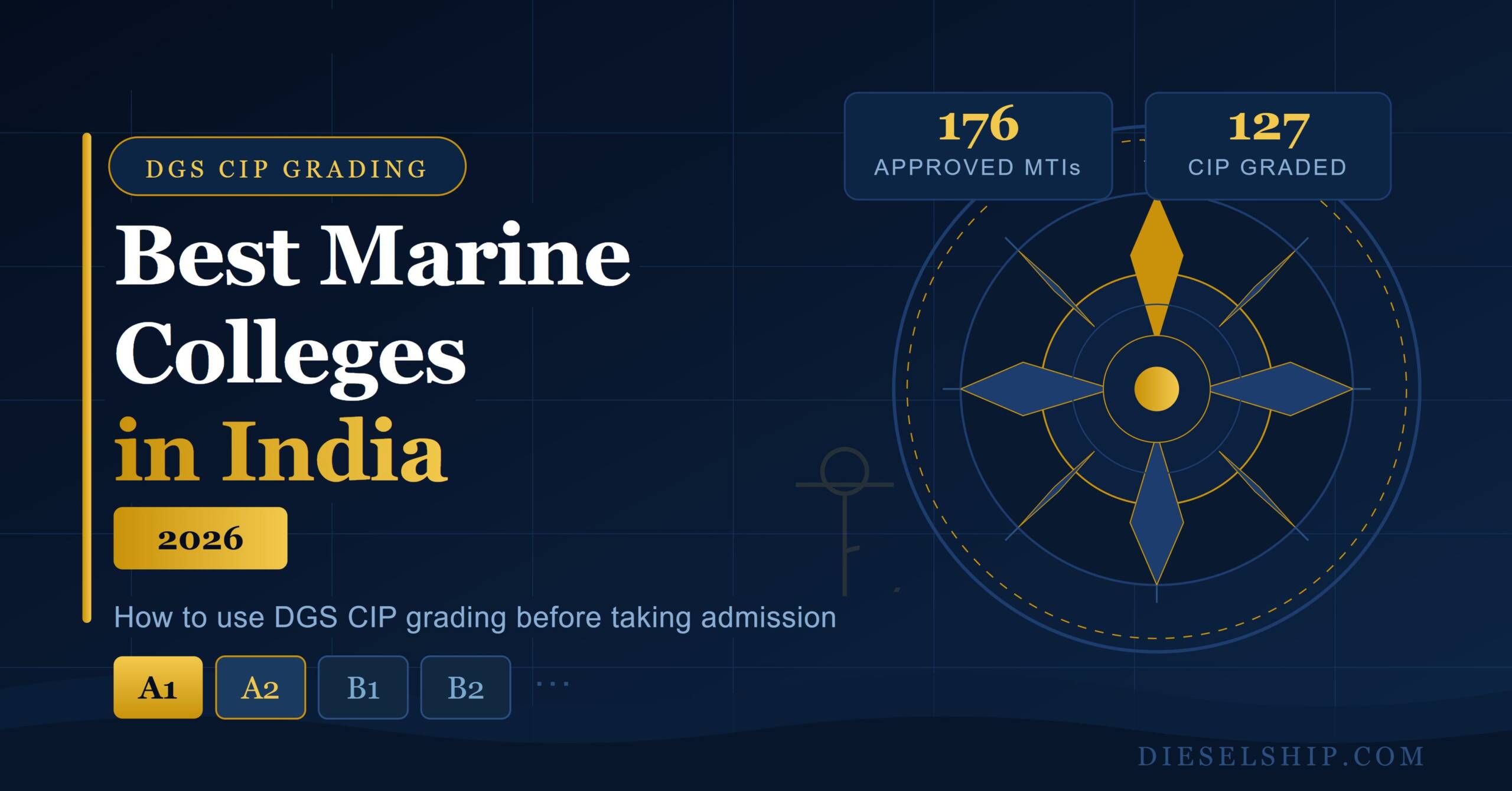
The July 2025 DGS CIP report gives a national snapshot of India’s maritime training ecosystem. It states that there were 176 DGS-approved MTIs, with 127 having CIP grading done, 17 with expired CIP, 16 closed/suspended, and 12 new MTIs.
Table 1 — National MTI snapshot from the July 2025 CIP report
| Category | Count | Interpretation for students |
|---|---|---|
| DGS-approved MTIs | 176 | Total approved maritime training institutes in the report snapshot |
| CIP grading done | 127 | Institutes with grading completed |
| Expired CIP | 17 | Require additional caution and latest verification |
| Closed / Suspended | 16 | Not suitable for standard shortlisting |
| New MTIs | 12 | Need careful checking on live approval and current standing |
Table 2 — Overall grade distribution among graded institutes
| Grade | Count | Meaning |
|---|---|---|
| A1 | 76 | Outstanding band under the DGS framework |
| A2 | 31 | Very good band |
| B1 | 11 | Good but not top-tier |
| B2 | 5 | Average and needs closer review |
| C1 | 2 | Below average |
| C2 | 1 | Poor |
| N/A | 1 | Not clearly graded in the report snapshot |
That tells students something important: many institutes perform strongly, but not every approved institute is equally strong. DGS approval and CIP grade are related, but they are not the same thing.
6. Why CIP matters especially for 10th and 12th pass students
The July 2025 report shows that among graded institutes, Pre-Sea institutes accounted for 59, compared with 38 Post-Sea Modular and 30 Post-Sea Competency institutes.
That makes CIP especially important for school-passout students planning to join entry-level maritime pathways such as DNS, B.Sc. Nautical Science, B.Tech Marine Engineering, GP Rating, or related pre-sea routes. In short, if you are joining after 10th or 12th, the Pre-Sea institute’s current CIP standing matters a lot.
7. How students should use DGS data correctly
The July 2025 CIP report is an official snapshot, but the beta DG Shipping Training Branch portal is the better source for current institute-level checking, because it provides a live List of approved MTIs and also links the CIP reporting section.
So the safest and most accurate process for students is:
Step 1
- Check whether the institute is DGS approved
Step 2
- Check whether the course is approved
Step 3
- Check the institute’s current CIP field/status on the live DG Shipping portal
Step 4
- Use the July 2025 CIP report for understanding the grading system and the national picture
Step 5
- Prefer institutes currently shown as A1 or A2 on the live portal
8. Who conducts the inspection?
The official DGS CIP report says that any Classification Society authorized by the Government of India as a Recognized Organisation and having entered into an agreement with DGS may offer its services for the inspection, gradation, and certification of maritime training institutes. The report also notes that an MTI has the liberty to choose any one RO for its CIP, although after three consecutive CIPs conducted by one RO, the institute must choose a different RO for the next CIP cycle.
On the current DG Shipping recognised organisations list, the major recognised bodies include Indian Register of Shipping (IRS), DNV, Korean Register of Shipping (KRS), Nippon Kaiji Kyokai or ClassNK, RINA India Private Limited, and Lloyd Register Asia. For students and parents, this matters because the grading is carried out through recognised technical bodies working within the DG Shipping framework rather than through self-assessment by the college.
Table 3 — Major recognised organisations relevant to CIP inspection in India
| Recognised Organisation | Short name | Why it matters in the article |
|---|---|---|
| Indian Register of Shipping | IRS | Major recognised technical body in India for inspection and certification activities |
| Lloyd Register Asia | LR | Recognised organisation within the DG Shipping framework |
| DNV | DNV | Recognised technical body used in classification and inspection systems |
| Nippon Kaiji Kyokai | ClassNK | Recognised organisation relevant to the inspection ecosystem |
| Korean Register of Shipping | KRS | Recognised organisation listed under DG Shipping |
| RINA India Private Limited | RINA | Recognised organisation operating in the official framework |
9. RPSL sponsorship and why it matters
Another point that students often hear about during admission is sponsorship. In the DG Shipping ecosystem, Recruitment and Placement Services are regulated through licensed RPS agencies. The official DGS RPS Agencies page provides the list of agents having Recruitment and Placement Services licences, along with advisories and withdrawal orders.
For students, this means that if a college or consultant talks about sponsorship, cadet placement, or company tie-ups, it is wise to verify whether the company or recruiting agency is linked to a valid DG Shipping-approved RPSL framework. A sponsorship claim carries more credibility when it is connected to the official DGS system rather than being presented only as a marketing promise.
In practical terms, students and parents should not rely only on verbal assurances of sponsorship. They should verify the recruiting company, the placement channel, and whether the agency or arrangement aligns with the official DG Shipping RPS structure before taking admission decisions based on sponsorship claims.
10. Practical advice for students and parents
Before paying fees or taking admission, students should verify four things on the official DGS ecosystem:
Verify institute approval
- Is the institute approved?
Verify course approval
- Is the specific course approved?
Verify current status
- What is the current CIP grade/status?
Verify caution signals
- Is there any expired, suspended, or regulatory caution attached to the institute?
That is a much better approach than trusting advertisements alone.
11. Conclusion
The DGS CIP framework is one of the most useful tools available for students trying to choose a marine college in India. The July 2025 CIP report explains what CIP is, how grading works, and how India’s maritime institutes are distributed across the grading bands, while the beta DG Shipping MTI portal helps verify the current institute-level position before admission. Together, these are the best official tools students can use to shortlist strong colleges and avoid making decisions based only on brand visibility or coaching-centre advice.
12. FAQ
| Question | Answer |
|---|---|
| What is CIP in marine colleges? | CIP is the Comprehensive Inspection Programme run under DGS to inspect and grade maritime training institutes in India. |
| What is the best CIP grade? | The highest official CIP grade is A1 – Outstanding, which is awarded to institutes scoring 90% and above. |
| Is DGS approval enough when choosing a marine college? | No. DGS approval shows the institute is recognized, but the CIP grade provides a better view of quality and current compliance. |
| Where can students check the latest grade of a marine college? | Students should check the official DG Shipping portal, especially the live List of approved MTIs and the official CIP report page. |
| Should students avoid every college below A1? | Not automatically. But A1 and A2 are generally the strongest choices under the DGS grading framework, while lower grades call for closer scrutiny. This is an editorial interpretation of the grading bands, not a separate DGS instruction. |
References & further reading
- 1. Directorate General of Shipping. Comprehensive Inspection Programme (CIP) Report – July 2025.
- 2. Directorate General of Shipping. DG Shipping Training Branch – List of Approved MTIs.
- 3. Directorate General of Shipping. List of Recognised Organisations.
- 4. Directorate General of Shipping. RPS Agencies Page.
- 5. Directorate General of Shipping. M.S. (STCW) Rules, 2014 and related training branch guidance.