

Metallurgical Influence of Alloying Elements on Cast Iron for Auxiliary Engine Components

Marine Engineering · Materials Science · Metallurgy
Metallurgical Influence of Alloying Elements on Cast Iron for Auxiliary Engine Components
A comprehensive examination of how silicon, chromium, manganese, and nickel transform the microstructure of cast iron to meet the extreme demands of marine auxiliary machinery.
Introduction to Auxiliary Marine Engine Metallurgy
Cast iron — a sophisticated iron-carbon alloy with carbon content exceeding 2% — serves as the undisputed structural backbone of heavy-duty mechanical and marine propulsion engineering. Its inherent physical and metallurgical attributes make it indispensable for fabricating intricate engine components.
Within maritime, industrial, and heavy-duty transport sectors, auxiliary engines function as critical non-propulsion power sources. These systems are responsible for driving essential shipboard operations: electrical power generators, high-capacity air compressors, hydraulic power packs, and extensive HVAC units.
Auxiliary engines — typically four-stroke trunk piston designs operating at medium to high rotational speeds — must endure virtually continuous operation. This relentless duty cycle subjects engine internals to severe thermal gradients, high-frequency mechanical and cyclic stresses, and prolonged exposure to highly aggressive corrosive media: from acidic combustion byproducts generated by heavy marine fuels, to the highly erosive effects of raw seawater in open-circuit cooling systems.
While unalloyed cast iron possesses valuable structural properties in its as-cast state, its full operational potential can only be unlocked through precise elemental alloying and sophisticated thermal manipulation — systematically optimising hardness, tensile strength, wear resistance, and thermal stability to prevent catastrophic failures that could disable essential vessel operations.
The Demanding Service Conditions
Auxiliary engine components face a simultaneous triad of severe degradation mechanisms — often acting in concert to accelerate failure far beyond what any single mechanism could achieve alone.
Exhaust manifolds and turbocharger housings regularly exceed 700°C, inducing thermal fatigue cracking and permanent structural "growth" — irreversible dimensional expansion driven by carbide decomposition and internal oxidation along graphite networks.
High-sulfur marine bunker fuels generate sulfuric acid condensate that penetrates cast iron along graphite flakes, forming voluminous corrosion products that generate internal stresses exceeding the tensile strength — leading to cracking and exfoliation.
Cylinder liners endure high-velocity piston ring sliding under boundary lubrication. Valve guides resist galling from titanium and austenitic steel stems. Pump casings face erosive and corrosive attack from continuously flowing saltwater combined with suspended particulates.
Silicon — The Master Graphitizer
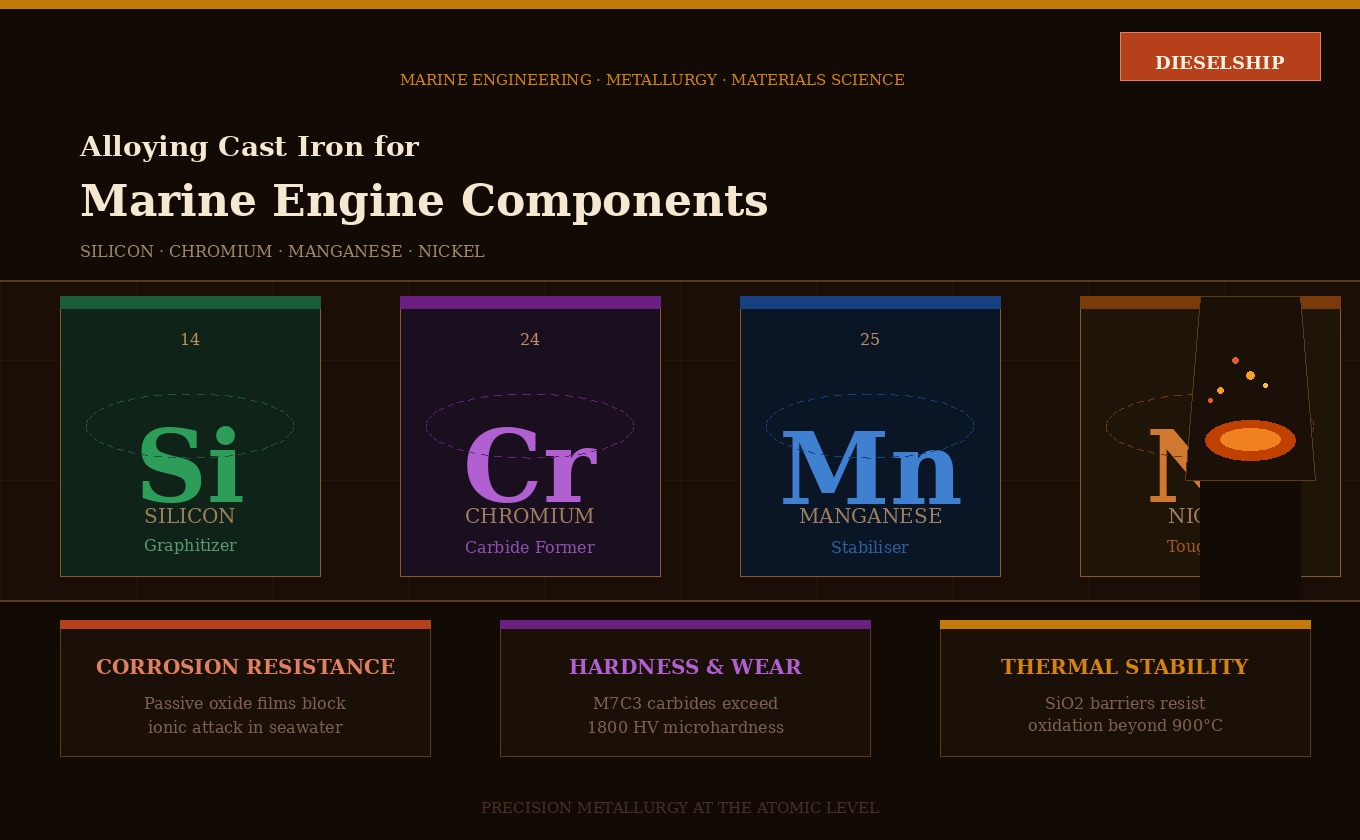
Silicon (Si)
Typical range: 1–3.5% in engine grades · Up to 14–17% in high-silicon grades (Duriron)
Graphitization Kinetics & Microstructural Evolution
Silicon fundamentally alters the iron-carbon phase diagram by increasing the stable eutectic temperature while decreasing the metastable eutectic temperature, widening the critical interval and heavily biasing solidification toward graphite precipitation over cementite formation. Each 1% silicon addition effectively reduces the carbon required to reach eutectic composition by approximately 0.33%.
Unlike chromium or molybdenum, silicon dissolves almost completely into the solid solution phase, partitioning into austenite or the resulting room-temperature ferrite. This solid-solution strengthening effect is highly pronounced — significantly surpassing the baseline strengthening of manganese, nickel, or chromium — dramatically increasing elastic limit, yield strength, and fatigue strength of the metallic matrix.
Thermal Stability & Mitigation of Structural Growth
Heavy silicon additions (typically 4–6%) fundamentally alter solid-state phase transformation dynamics by significantly elevating the eutectoid transformation temperature (the A₁ critical temperature). By pushing this phase transition boundary higher than the peak operating temperature of the exhaust gas environment, silicon prevents the matrix from cycling between ferritic and austenitic states — eliminating the primary mechanism driving thermal fatigue and dimensional distortion.
Oxidation Resistance — The Silica Barrier
Silicon exhibits exceptional thermodynamic affinity for oxygen — greater than iron, chromium, or manganese. During high-temperature service, silicon atoms migrating to the surface react with atmospheric oxygen to form a dense, continuous, adherent silicon dioxide (SiO₂) film. This amorphous layer severely retards the outward ionic migration of iron cations and completely blocks inward penetration of oxygen anions — drastically minimising surface scaling and deep internal oxidation.
Dense SiO₂ passive film acts as an impermeable diffusion barrier against ionic attack. High-Si grades (14–17%) provide near-total immunity to sulfuric acid environments.
Promotes graphitisation at moderate levels (1–3%), aiding machinability. At elevated concentrations, iron silicide phase formation increases hardness and wear resistance.
Raises the critical A₁ transformation temperature, reduces thermal expansion coefficient, and dramatically suppresses structural growth at service temperatures up to 800–900°C.
Chromium — The Hardener & Passivator
Chromium (Cr)
Typical range: 0.5–3.5% in low-alloy · 15–28% in High-Chromium Cast Iron (HCCI)
Carbide Precipitation & Tribological Hardening
Chromium serves the diametrically opposite function to silicon — acting as a highly potent carbide former. When elevated significantly in HCCI formulations (15–28% Cr, 2–3.5% C), chromium heavily partitions into the carbide phases during solidification, forming complex eutectic carbides — predominantly M₇C₃ and M₂₃C₆ structures where M represents a stoichiometric combination of iron and chromium atoms.
The M₇C₃ carbides possess a dense hexagonal close-packed (HCP) crystalline structure with exceptional microhardness frequently exceeding 1800 HV. These ultra-hard carbide networks embedded within an austenitic or martensitic matrix provide unparalleled resistance to severe abrasive wear, rendering chromium an essential alloying element for components subjected to high-pressure boundary friction.
Sophisticated heat treatments — austenitising at 950–1000°C, rapid oil quenching, and tempering at ~260°C — force retained austenite to transform into highly durable tempered martensite, achieving an optimal metallurgical balance of extreme hardness (up to 62–66 HRC) while preserving sufficient impact strength to survive engine vibrations.
High-Temperature Passivity & Corrosion Resistance
Chromium is the singular primary element responsible for establishing chemical passivity in cast irons exposed to corrosive fluids, acidic condensates, and high-temperature oxidising gases. Chromium atoms rapidly oxidise at the surface to form a thin, invisible, highly stable and continuous Cr₂O₃ passivation layer — an inert chemical shield that prevents uniform surface corrosion and heavily mitigates localised galvanic or pitting attacks driven by chloride ions.
Critically, the overall corrosion resistance of high-chromium white irons is largely dependent on the bulk quantity of chromium remaining dissolved within the metallic matrix (solid solution), rather than the chromium tied up within carbide phases. Formulating HCCI alloys with sufficient chromium "overage" — ensuring the matrix retains high localised chromium concentration even after carbide precipitation — is critical to ensuring the component retains both passivity and wear resistance simultaneously.
Self-healing Cr₂O₃ passive film. Above 12% Cr, provides stainless-grade protection against seawater, sulfuric acid, and steam.
M₇C₃ carbides reach 1200–1800 HV. Bulk hardness exceeds 600–700 HB in HCCI grades. Refines pearlite at low additions.
Chromium carbides resist coarsening. Raises A₁ temperature and suppresses graphite oxidation by forming a protective surface oxide.
Manganese — The Matrix Stabiliser
Manganese (Mn)
Typical range: 0.5–1.3% in engine grades · Up to 6–8% in austenitic grades
Sulfur Neutralisation & Prevention of Hot Shortness
During smelting and casting, sulfur acts as a highly detrimental tramp element. Unchecked, sulfur combines with iron to form iron sulfide (FeS) — which possesses a significantly lower melting point than the surrounding matrix, causing it to remain liquid late in solidification and solidify into brittle, continuous grain boundary films. Under operational thermal or mechanical stress, these films induce "hot shortness" — catastrophic embrittlement, hot tearing, and spontaneous cracking of the casting.
Manganese completely neutralises this threat. It possesses a significantly higher thermodynamic affinity for sulfur than iron, selectively reacting to precipitate manganese sulfide (MnS) inclusions. Unlike FeS, MnS possesses a high melting point and precipitates harmlessly as isolated, globular particles within the melt — prior to eutectic solidification — without compromising grain boundary integrity. Thermodynamic stoichiometry dictates the manganese concentration must be maintained at a minimum 1.7× the sulfur concentration.
Pearlite Stabilisation & Mechanical Strengthening
Once sulfur has been fully neutralised, free manganese dissolves into the metallic matrix, inhibiting the decomposition of austenite into free ferrite and graphite during the eutectoid transformation — forcing carbon to remain combined and promoting a fully pearlitic microstructure. Manganese further refines the interlamellar spacing of the resulting pearlite, significantly increasing bulk hardness, tensile strength, and abrasive wear resistance.
Research demonstrates that the mechanical strength of gray iron is absolutely optimised when manganese and sulfur are precisely balanced at the solubility limit of MnS at the eutectic temperature — when the product of their weight percentages [%Mn × %S] equals 0.026 to 0.030. Exceeding this limit leads to brittle intercellular carbides and highly detrimental type-D graphite structures, severely reducing strength.
Complex Electrochemical Behaviour
In highly corrosive environments, manganese exhibits a dual nature. While definitively improving mechanical stability and wear, manganese is electrochemically more reactive than base iron. XPS analysis reveals that in aggressive acidic conditions, free manganese rapidly oxidises into MnO and MnO₂ particles, significantly altering the electrochemistry of the rust layer — increasing electron transfer pathways that facilitate preferential cathodic reactions rather than formation of stable protective oxide phases. Consequently, excessive manganese concentrations (above 1.5%) in low-alloy cast irons can actually reduce chemical resistance in sulfuric acid environments unless simultaneously balanced by passivating chromium.
Eliminates detrimental FeS grain boundary films that act as anodic corrosion initiation sites. Dual nature at higher concentrations in acid environments.
Promotes fully pearlitic microstructure and refines interlamellar spacing. Linear correlation between Mn content and reduced abrasive wear rates.
Improves matrix toughness and resistance to thermal shock. Reduces tendency for embrittlement at intermediate temperatures.
Nickel — The Austenite Stabiliser
Nickel (Ni)
Typical range: 1–4% in low-alloy grades · 13–22% in Ni-Resist austenitic grades · 3–5% in Ni-Hard
Nickel is widely regarded as the most important alloying addition to cast iron beyond the primary trio of silicon, chromium, and manganese. Unlike chromium, which primarily forms carbides, nickel dissolves almost entirely in the iron matrix — making it a powerful matrix stabiliser and toughness enhancer, addressing cast iron's most significant inherent weakness.
Corrosion Resistance — The Ni-Resist Family
Nickel dramatically improves corrosion resistance through two mechanisms. At higher additions, it stabilises a fully austenitic matrix — inherently more corrosion resistant than ferritic or pearlitic matrices due to its single-phase, low-energy grain boundary structure. Nickel also enriches the surface oxide layer, making it more stable and adherent in aggressive environments.
The most important commercial outcome is Ni-Resist austenitic cast iron (typically 14–22% Ni, with Si, Cr, and Mn), classified under ASTM A436 — the industry standard for corrosion-critical cast iron components. Its austenitic matrix resists both general corrosion and pitting attack that would rapidly destroy plain cast iron pump bodies and valve housings in marine service.
Thermal Stability — FCC Advantage
The austenitic matrix stabilised by nickel has a face-centred cubic (FCC) crystal structure — inherently more ductile and thermally stable than the body-centred cubic (BCC) ferritic or pearlitic matrix of plain cast iron. Key benefits include resistance to thermal growth, tailorable thermal expansion coefficient to match mating components, and retention of toughness at cryogenic temperatures relevant to LNG auxiliary equipment.
Toughness — Addressing Cast Iron's Key Weakness
This is nickel's most unique contribution. Plain cast iron is notoriously brittle — failing without warning under impact due to stress-concentrating graphite flakes. Nickel improves matrix toughness by refining graphite flake size at low additions, stabilising austenite (which has inherently higher fracture toughness than pearlite or martensite), and reducing the ductile-to-brittle transition temperature — making nickel-alloyed cast iron suitable for components subject to pressure surges, water hammer, and vibration shock.
| Alloy System | Nominal Composition | Microstructure | Key Properties |
|---|---|---|---|
| Ni-Resist Type 1 | 13.5–17.5% Ni, 1.75–2.5% Cr, 5.5–7.5% Cu | Austenitic | Seawater corrosion resistance, moderate strength |
| Ni-Resist Type 2 | 18–22% Ni, 1.75–2.25% Cr | Austenitic | Higher corrosion & thermal resistance |
| Ni-Hard Type 1 | 3.3–5% Ni, 1.5–3% Cr | Martensitic white iron | Extreme abrasion hardness (550–700 HB) |
| Ni-Hard Type 4 | 4.5–6.5% Ni, 8–10% Cr | Martensitic + carbides | Combined abrasion & corrosion resistance |
Synergistic Elemental Interactions
The true metallurgical potential of cast iron for extreme marine applications is realised not through single-element additions, but through highly engineered, synergistic interactions of multi-component alloying systems.
Silicon + Chromium Synergy
Silicon forces graphitisation while chromium forces carbide precipitation — diametrically opposing forces that, when precisely balanced, create optimal microstructure. Silicon increases the effective interdiffusion coefficient of chromium, assisting rapid surface migration of chromium atoms to re-establish the protective Cr₂O₃ scale if mechanically disrupted. The resulting multi-layered oxide scale — with an outer Fe₂O₃/Fe₃O₄ layer, an inner spinel phase, and a continuous SiO₂ sub-layer — exponentially decreases oxygen permeability, shutting down oxidation entirely.
Manganese + Chromium Synergy
While chromium provides the primary Cr₂O₃ barrier at the surface, manganese acts internally to refine the underlying microstructure and modify detrimental iron-rich intermetallic phases. Manganese atoms substitute into the crystal lattice, transforming sharp, brittle needle-like β-AlFeSi phases into favourable cubic α-Al(Fe,Mn)Si phases with dendritic structure — preventing the passive chromium oxide layer from being physically fractured from the inside by sharp internal crystals.
Silicon + Molybdenum + Chromium
For components facing the absolute maximum thermal loads — direct exhaust interfaces of turbocharged diesel engines — binary alloys fail, necessitating ternary Si-Mo-Cr arrays. While silicon prevents scaling via SiO₂ formation and raises the transformation temperature, the integration of molybdenum completely arrests high-temperature mechanical creep by precipitating highly stable, refractory Mo₂C carbide networks — acting as a microscopic internal skeleton that locks grain boundaries in place.
| Element | Corrosion Resistance | Hardness | Thermal Stability | Unique Contribution |
|---|---|---|---|---|
| Silicon (Si) | SiO₂ passive film | Moderate (solid solution) | Oxidation resistance to 900°C | Graphite morphology control |
| Chromium (Cr) | Cr₂O₃ passive film | Strong carbide hardening | Carbide thermal stability | Extreme wear resistance |
| Manganese (Mn) | Eliminates FeS sites | Pearlite refinement | Matrix toughness | Desulphurisation |
| Nickel (Ni) | Austenitic matrix stability | Work hardening + refining | FCC stability, low-temp toughness | Toughness & austenite stabilisation |
Component Application Case Studies
The strategic elemental manipulation of cast iron metallurgy allows marine engineers to design components tailored with precision to the highly localised thermal, tribological, and chemical stresses found within different sectors of auxiliary marine diesel engines.
Centrifugal casting pushes lighter impurities to the inner bore while compacting pure iron against the die wall. The resulting dense, pearlite-dominant structure features Type-A graphite flakes that act as microscopic oil reservoirs — preventing seizure when the hydrodynamic oil film breaks down at top dead center. Chromium guarantees matrix passivity against sulfuric acid condensation; Ni and Mo enhance high-temperature tensile strength. Cast iron liners safely accommodate hard-faced DLC or chrome-plated rings, providing decades of reliable service.
Standard gray iron is entirely insufficient for manifold temperatures exceeding 700°C — highly prone to structural growth, intergranular oxidation, and thermal fracture. SiMo ductile cast iron (4–5% Si, 0.5–1% Mo) is universally specified. High silicon promotes a fully ferritic matrix with superior thermal conductivity; molybdenum forms stable Mo₂C carbide networks to dramatically enhance creep resistance. Magnesium treatment forces graphite to precipitate as isolated spheres, eliminating stress-concentrating crack propagation pathways of gray iron.
Modern marine exhaust valves are manufactured from austenitic stainless steels or are heavily hard-chrome plated. The graphite-rich, pearlitic microstructure of alloyed cast iron guides ensures completely dissimilar metallic contact — utterly eliminating adhesive galling risk while providing exceptional abrasive wear resistance. Valve guides are austenitised, oil-quenched, and tempered to achieve 35–45 HRC, ensuring a durable matrix of tempered martensite supported by a robust network of intercellular carbides.
Standard unalloyed gray irons are permissible only for low-pressure treated freshwater circuits. For raw seawater, metallurgical specification transitions to Austenitic Ni-Resist (ASTM A436) — where nickel and manganese stabilise the FCC austenitic matrix down to room temperature, resisting galvanic coupling and uniform anodic corrosion. Simultaneous chromium additions introduce finely dispersed carbides combating erosive mechanical wear. For extreme slurry applications, ASTM A532 Class III Type A HCCI (25–28% Cr) provides up to 700 HB hardness.
Turbocharger housings endure exhaust gas temperatures of 600–750°C combined with high rotational stresses and thermal cycling. Ni-Resist Type 2 (18–22% Ni) is extensively used in marine diesel turbochargers — withstanding extreme temperatures, resisting oxidation scaling, and maintaining dimensional stability through thermal cycling. The stable austenitic FCC matrix resists the "growth" phenomenon that would cause catastrophic dimensional changes in standard gray iron.
Large structural castings benefit from cast iron's inherent advantages — excellent castability, near-net-shape production, vibration damping, and dimensional stability. Silicon (1.8–2.4%) controls graphitisation and provides solid-solution strengthening; manganese (0.6–0.9%) ensures freedom from hot-shortness defects while maximising pearlite volume fraction for optimal strength. The combination delivers reliable dimensional stability over decades of thermal cycling.
Advanced Microstructural Degradation
Understanding the long-term behaviour of auxiliary engine components requires examination of the advanced microstructural growth mechanisms at play — specifically the intricacies of graphitisation and high-temperature internal oxidation.
Graphite crystallisation within the molten cast iron matrix is a highly complex, two-stage phenomenon governed by local melt supersaturation of carbon, undercooling thermal gradients, and the presence of compatible nucleating substrates. According to contemporary nucleation models pioneered by researchers including John Campbell, the uncoupled growth of flake graphite relies heavily on entrained microscopic oxide bifilms.
During violent turbulence of smelting, pouring, and casting, liquid metal folds over on itself, entraining its own oxidised surface layer and introducing microscopically thin, doubled-over SiO₂ bifilms into the bulk liquid metal. These suspended ceramic films act as preferred planar nucleation substrates, encouraging carbon atoms to precipitate and grow along their vast surface areas — resulting in the extensive, highly interconnected flake graphite networks characteristic of standard gray iron.
In the critical metallurgical transition from gray iron to ductile (nodular) iron, the precise addition of magnesium chemically attacks and neutralises these silica bifilms, transforming them into complex magnesium silicate (Mg₂SiO₄) structures — destroying the flat planar substrates and forcing precipitating graphite to nucleate spherically upon itself. This completely eliminates sharp, linear stress concentrations and crack propagation pathways, drastically improving tensile strength and impact ductility.
Under sustained extreme thermal loads, extensive graphite networks become critical vulnerabilities. High-temperature structural "growth" occurs via two simultaneous destructive pathways: the slow solid-state thermal decomposition of remaining pearlite/carbides into bulky, low-density free graphite, and aggressive internal oxidation of the iron matrix. Atmospheric oxygen penetrates deep into the component by travelling along the microscopic, interconnected pathways provided by flake or vermicular graphite networks — reacting with surrounding iron and silicon atoms to form vast networks of internal oxides (Wüstite FeO, Hematite Fe₂O₃, and Silica SiO₂).
Because these oxidised ceramic compounds possess a significantly larger specific crystalline volume than the dense base metal they replace, their continuous formation generates massive, unrelenting internal swelling stresses — physically forcing the component to "grow" in size, warping mating surfaces, shearing mounting bolts, and ultimately leading to catastrophic fracture. This fundamental degradation pathway underscores the absolute critical importance of the synergistic high-alloying strategies discussed throughout this article.
- Cast iron. Wikipedia. Accessed March 30, 2026.
- Heat treatment of cast iron main engine components. DieselShip. 2026.
- The Use and Advantages of Cast Irons. IMarEST Library. Record 493.
- Factors to Consider While Choosing the Best Diesel Marine Engine. MHI. 2026.
- Auxiliary Engines Explained. Diesel Services of America. 2026.
- Marine Engine Core Internals: Parts, Cooling, Design. MarinePublic. 2026.
- Study on the Corrosion and Wear Mechanism of a Core Friction Pair in Methanol-Fueled ICEs. MDPI Materials. 2025.
- Materials Selection for Seawater Pumps. Turbomachinery Laboratory, Texas A&M University. 2018.
- Effect of manganese, silicon and chromium additions on microstructure and wear characteristics of grey cast iron for sugar industries applications. ResearchGate. 2017.
- Effect of Alloying Element in Cast Iron. NIAMT Technical Report, Topic 9.
- Sulfuric acid corrosion resistance of high gray cast iron. Feixiang Industry Pump. 2026.
- Experimental Investigation of Sulfuric Acid Condensation and Corrosion Rate in Motored Bukh DV24 Diesel Engine. DTU Research Database.
- Preparation and Mechanical Properties of High Silicon Molybdenum Cast Iron Materials. PMC / NCBI. 2024.
- Diesel Exhaust Manifolds: Material. MDCDiesel Blog. 2026.
- Research on the Oxidation Mechanism of Vermicular Graphite Cast Iron. PMC / NIH. 2019.
- Investigation of silicon carbide dissolution behavior in molten cast iron. University of Duisburg. Giesserei Special.
- Valve guides — Materials and usage. Calver ST Technical Information. 2026.
- Analysis of Engine Cylinder Liners. IRJET, Vol. 2, Issue 9. 2015.
- Influence of Silicon on Solidification Behavior, Microstructure and Oxidation Resistance of Gray Iron for Cookware Applications. ResearchGate. 2024.
- Influence of the silicon in high chromium cast iron. Sialloy Blog. 2026.
- Effects of Silicon on the Oxidation Behavior of Ni-Base Chromia-Forming Alloys. ResearchGate. 2003.
- Research Progress on Alloying of High Chromium Cast Iron — Austenite Stabilizing Elements. MDPI Crystals. 2025.
- Influences of Cr on the microstructural, wear and mechanical performance of high-chromium white cast iron grinding balls. Journal of Materials and Manufacturing.
- Corrosion Wear of Hypereutectic High Chromium Cast Iron: A Review. MDPI Metals. 2023.
- The Improvement of Wear and Impact Resistance of High Chromium White Cast Iron for Crusher. Gadjah Mada University Journal. 2021.
- Abrasion-Resistant Cast Iron ASTM A532 Class III Type A. CastingQuality.com. 2026.
- Role of manganese in cast iron. AskFilo Smart Solutions. 2026.
- Strengthening high strength gray cast iron by adjusting the content of Mn and S. ZHY Casting. 2026.
- Finding the Right Balance of Manganese and Sulfur to Increase Cast Iron Strength. Modern Casting. 2018.
- Effect of Mn on Corrosion Resistance of Low-Cr Weathering Steel. MDPI Metals. 2024.
- Cylinder liners. Faculty of Maritime Studies Rijeka (PFRI). Technical Document BP.
- Tribological Properties of Aluminum-Silicon Alloy Cylinder Liners Paired with DLC and CKS Piston Rings. MDPI Lubricants. 2025.
- Novel study on investigating the mechanical, microstructure morphological, and dry sliding wear characteristics of grey cast iron GG25 with copper additions for valve guides. Frontiers in Materials. 2023.
- Heat treated valve guide and method of making. US Patent 7,628,870 B2. Google Patents.
- Mechanisms of Graphite Growth in Cast Iron (Campbell Nucleation Model). Scribd Document. 2023.