
MARPOL, Uncategorized

MARPOL Annex VI NOx & SOx Emission Limits – Regulations, Tiers & Compliance Measures

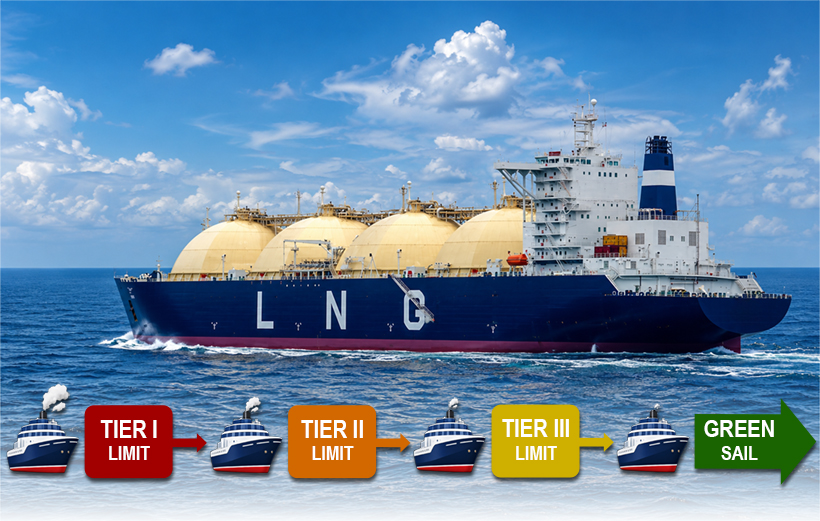
Maritime Emissions Regulation · Technical Reference

NOx & SOx Emission Limits

MARPOL Annex VI — Regulations 13 & 14  |  Applicable Standards for Marine Vessels

  • MARPOL 73/78
  • ANNEX VI
  • REG. 13 — NOx
  • REG. 14 — SOx
  • IMO 2020 COMPLIANT
Regulation 13

NOx — Oxides of Nitrogen Limits

Applicable to all marine diesel engines with a power output greater than 130 kW installed on ships constructed on or after 1 January 2000. Limits are expressed in total weighted NOx (as NO₂) in grams per kWh and are a function of rated engine speed (n, rpm).

TierShip build dateApplicable areaLimit at n < 130 rpmLimit at 2000+ rpm
Tier IOn/after 1 Jan 2000Global (all waters)17.0 g/kWh9.8 g/kWh
Tier IIOn/after 1 Jan 2011Global (all waters)14.4 g/kWh7.7 g/kWh
Tier IIIOn/after 1 Jan 2016NECAs only3.4 g/kWh1.96 g/kWh
Tier I formula 45 · n−0.2  (130 ≤ n < 2000)
Tier II formula 44 · n−0.23  (130 ≤ n < 2000)
Tier III formula 9 · n−0.2  (130 ≤ n < 2000)
Designated NECAs (NOx Emission Control Areas): North American ECA, US Caribbean ECA, Baltic Sea ECA and North Sea ECA (Tier III effective 1 May 2021). Outside NECAs, Tier III ships revert to Tier II compliance. Compliance verified via the EIAPP Certificate and NOx Technical File.

Regulation 14

SOx — Oxides of Sulphur Limits

Controlled through maximum permitted sulphur content in fuel oil. Applies to all ships without exception. Stricter limits apply within designated Sulphur Emission Control Areas (SECAs).

PeriodGlobal sulphur cap (% m/m)SECA sulphur cap (% m/m)
Before 1 January 20124.50 %1.50 %
1 January 2012 – 31 December 20193.50 %0.10 % (from 1 Jan 2015)
From 1 January 2020 (IMO 2020)0.50 %0.10 %
Designated SECAs: Baltic Sea, North Sea, North American ECA, US Caribbean ECA.
Compliance options: (1) Low-sulphur fuel oil — VLSFO ≤ 0.50% S globally, MGO ≤ 0.10% S in SECAs; (2) Approved Exhaust Gas Cleaning System (EGCS/scrubber); (3) Alternative fuel — LNG, methanol, ammonia (inherently sulphur-free).
Regulation 18: Bunker Delivery Notes (BDN) must be retained for 3 years; MARPOL fuel samples for 12 months. Fuel oil changeover log entries are mandatory on SECA entry/exit.

Compliance Strategies · Technical & Operational

Measures to Reduce NOx & SOx Emissions

NOx — Technical Measures
TECH
Selective Catalytic Reduction (SCR): Urea (AdBlue) injected into exhaust reacts with NOx over a catalyst to produce harmless N₂ and H₂O. Achieves 80–95% NOx reduction; primary Tier III solution.
TECH
Exhaust Gas Recirculation (EGR): 20–40% of exhaust recirculated into charge air, diluting O₂ and lowering peak combustion temperature. Reduces NOx by 30–50%; widely used on two-stroke crosshead engines.
TECH
Miller Cycle & Injection Timing: Early intake valve closing and retarded fuel injection timing reduce charge temperature and peak cylinder pressure, limiting thermal NOx by 10–25%.
TECH
Humid Air Motor (HAM) / Water Injection: Humidified scavenging air or direct water injection into the combustion chamber reduces flame temperature. Achieves 30–70% NOx reduction.
TECH
Alternative Fuels (LNG, Methanol): LNG combustion inherently produces lower NOx due to lower stoichiometric flame temperature. Dual-fuel engines permit fallback to liquid fuel.
SOx — Technical Measures
TECH
Open-Loop Scrubber (EGCS): Seawater scrubs SO₂ from exhaust and is discharged back to sea after alkalinity treatment. Permits HSFO use; prohibited in some port states and enclosed waters.
TECH
Closed-Loop Scrubber: NaOH-dosed freshwater recirculated through scrubber; wash water retained onboard for shore disposal. Compliant in all ports and SECAs.
TECH
Hybrid Scrubber: Capable of switching between open-loop and closed-loop modes, providing flexibility across varying port-state wash water discharge regulations.
TECH
VLSFO / MGO / LSFO: Very Low Sulphur Fuel Oil (≤ 0.50% S) globally and Marine Gas Oil (≤ 0.10% S) within SECAs provide direct compliance without additional hardware.
TECH
Alternative Fuels (LNG, Methanol, NH₃): Inherently sulphur-free; provide simultaneous SOx and (partially) NOx compliance. LNG offers near-zero SOx and significant GHG reduction potential.
NOx — Operational Measures
OPS
Slow Steaming: Reduced engine load lowers combustion temperatures and NOx output. Effective combined with load-optimised injection timing to prevent incomplete combustion.
OPS
NECA Mode Switching: SCR or EGR activation procedure verified and completed before NECA entry. A written switchover log is mandatory; failure to activate constitutes non-compliance.
OPS
Engine Maintenance & Tuning: FIE maintenance (nozzle condition, timing) within NOx Technical File parameters. Regular indicator cards and performance analysis detect compliance drift.
OPS
Voyage Planning: Routing to minimise transits in NECAs where Tier III applies. Shore-side optimisation reduces unnecessary NECA exposure for non-Tier III equipped vessels.
SOx — Operational Measures
OPS
Fuel Changeover Procedure: Changeover from HSFO to LSFO/MGO completed before SECA entry. Position, time, and tank figures recorded in the Fuel Oil Changeover Log (Reg. 14.6).
OPS
Bunker Management: Procuring compliant fuel, verifying BDN sulphur content, retaining MARPOL representative samples onboard for 12 months for PSC inspection.
OPS
EGCS Monitoring & Records: Continuous pH/PAH/turbidity monitoring of scrubber wash water; data logger records retained. Scrubber approval document and discharge data must be available for PSC.
OPS
SEEMP & ISM Compliance: Fuel management integrated into Ship Energy Efficiency Management Plan. Operator instructions, drills, and checklists for SECA entry/exit under the ISM Code SMS.

IMO 2020 Global Sulphur Cap — Key Impact

From 1 January 2020, the global sulphur cap was reduced from 3.50% to 0.50% m/m, representing an 85% reduction in allowable sulphur content. The shipping industry responded through a combination of VLSFO uptake, scrubber retrofits, and accelerated LNG adoption, resulting in an estimated reduction of 8.5 million tonnes of SO₂ emissions annually.

Compliance Summary
MeasureNOx reductionSOx reductionTier III capableAlt. fuel req.
SCR (urea catalyst)80 – 95%
EGR30 – 50%✔ (combined)
Miller cycle / retarded timing10 – 25%
EGCS Scrubber (open/closed)> 97%
VLSFO / MGO fuel switchFull compliance
LNG / methanol / ammoniaSignificantFull compliance✔ (LNG + SCR)
Slow steaming (operational)ModerateProportional

Leave a Reply

Your email address will not be published. Required fields are marked *