Q1. a) State the reasons for the freeboard requirement. (6)
b) Explain the term condition of assignment and explain how these are maintained for a ship. (5)
c) What is the difference between a Type “A” and a Type “B” ship. (5)
Q5. a) Sketch the cross-section of a bulk carrier with either deep or shallow double bottom showing the type of framing used. (8)
b) i) Describe the corrosion problems experienced with ballast tanks. (4)
ii) State how such tanks are protected against extensive corrosion. (4)
Q3. a) With the aid of a sketch describe the method of attachment for a bilge keel and hence explain what protection is made to reduce the possibility of the shell being punctured in the event of damage to the keel. (6)
b) State why the keel does not extend for the length of the ship. (5)
c) Evaluate the effectiveness of bilge keels for large wall sided vessels. (5)
Q2. a) Draw a simple line diagram of the bow of a ship to show the position of the following component parts of the ships anchoring system. Hawse pipe, Cable stopper, Windlass and Cable lifter, Spurling pipe and Chain locker. (6)
b) Describe the cable stopper and state its purpose. (3)
c) Show by means of a sketch how the anchor cable is attached to the ship. (3)
d) Describe how the chain locker is drained of water, sand and mud. (4)
Q5. With reference to membrane tanks for the carriage of liquefied gas at very low temperatures.
a) Describe with a sketch one method of building up the insulation. (6)
b) State which alloy is used for the membrane and the reason. (5)
c) Explain why a secondary barrier is installed. (5)
Q6. a) Describe how the distribution of mass within the ship affects the rolling period. (6)
b) The righting moments of a ship at angles of heel of 0, 15°, 30°, 45°, and 60° are 0, 1690, 5430, 9360 and 9140 kN-m respectively. Calculate the dynamical stability at 60°. (10)
Q7. a) Describe briefly the significance of the factor of subdivision. (6)
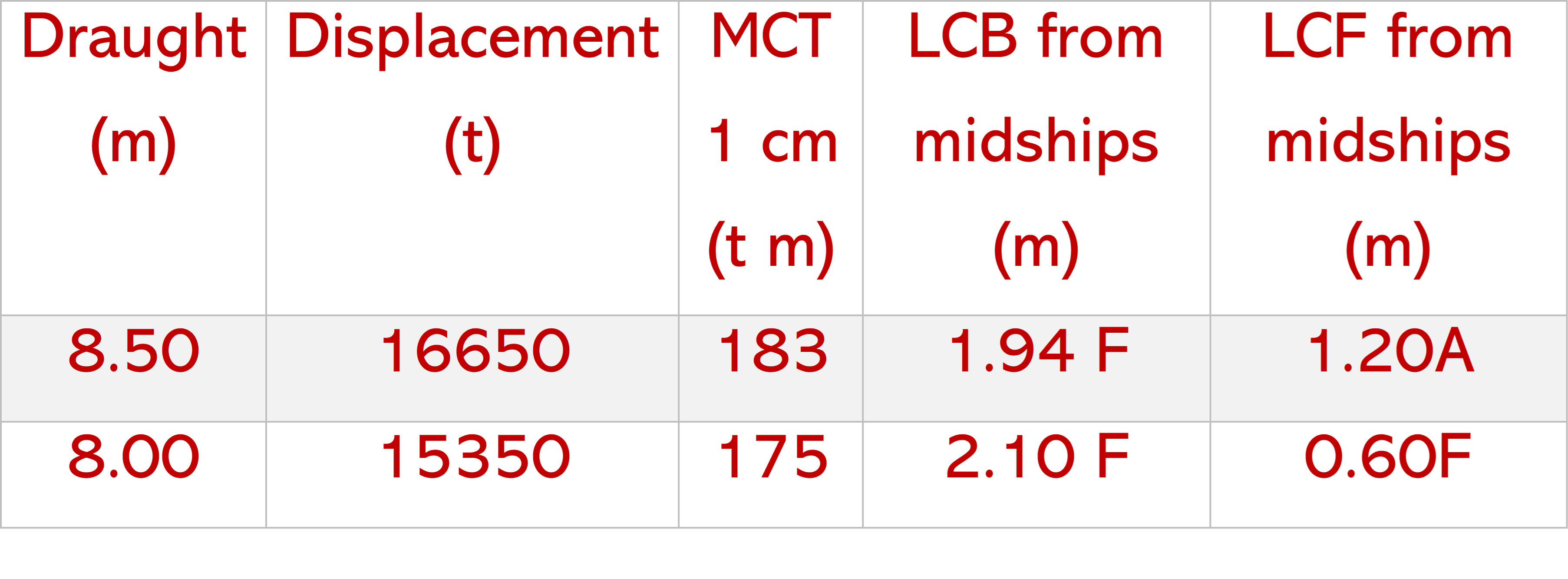
b) A ship 120m long has a light displacement of 4000 tonne and LCG in this condition 2.5m aft of midships. (10)
The following items are then added:
Cargo 10000 tonne LCG 3.0 m forward of midships
Fuel 1500 tonne LCG 2.0 m aft of midships
Water 400 tonne LCG 8.0 m aft of midships
Stores 100 tonne LCG 10.0m forward of midships
Using the following hydrostatic data, calculate the final draughts:
Q8. A) Explain how the distribution of masses affects rolling and pitching. (6)
B) A ship turns in a circle of radius 100 metres at a speed of 15 knots. The GM is 2/3 metres and BG is 1 metre. If g = 981 cm/sec2 and 1 knot is equal to 1.8532 Km/hour, find the heel due to turning. (10)
Q9. A) Describe the effect of cavitations on the propeller blades. (6)
B) A propeller 4.6m diameter has a pitch of 4.3m and boss diameter of 0.75 m. The real slip is 28% at 95 rev/min. Calculate the speed of advance, thrust and thrust power. (10)
Q10. A) Describe the stability requirements of a ship for dry-docking. (6)
B) A ship 130m long displaces 14000 tonne when floating at draughts of 7.5m forward and 8.10m aft. GML – 125m, TPC – 18, LCF-3m aft of midships. Calculate the final draughts when a mass of 180 tonne lying 40m aft of midships is removed from the ship. (10)
Username or email address *Required
Password *Required
Note: Entering wrong username in the login form will ban your IP address immediately. Entering wrong password multiple times will also ban your IP address temporarily.
Log in
Lost your password? Remember me
No account yet?
DieselShip support
Send us a message and we'll reply by email, usually within one business day.
We've logged your ticket and sent a confirmation to your email.