

Technical Analysis of Sustained Low-Load Operation in Marine Two-Stroke Propulsion Systems: Pathologies, Risks, and Engineering Mitigation

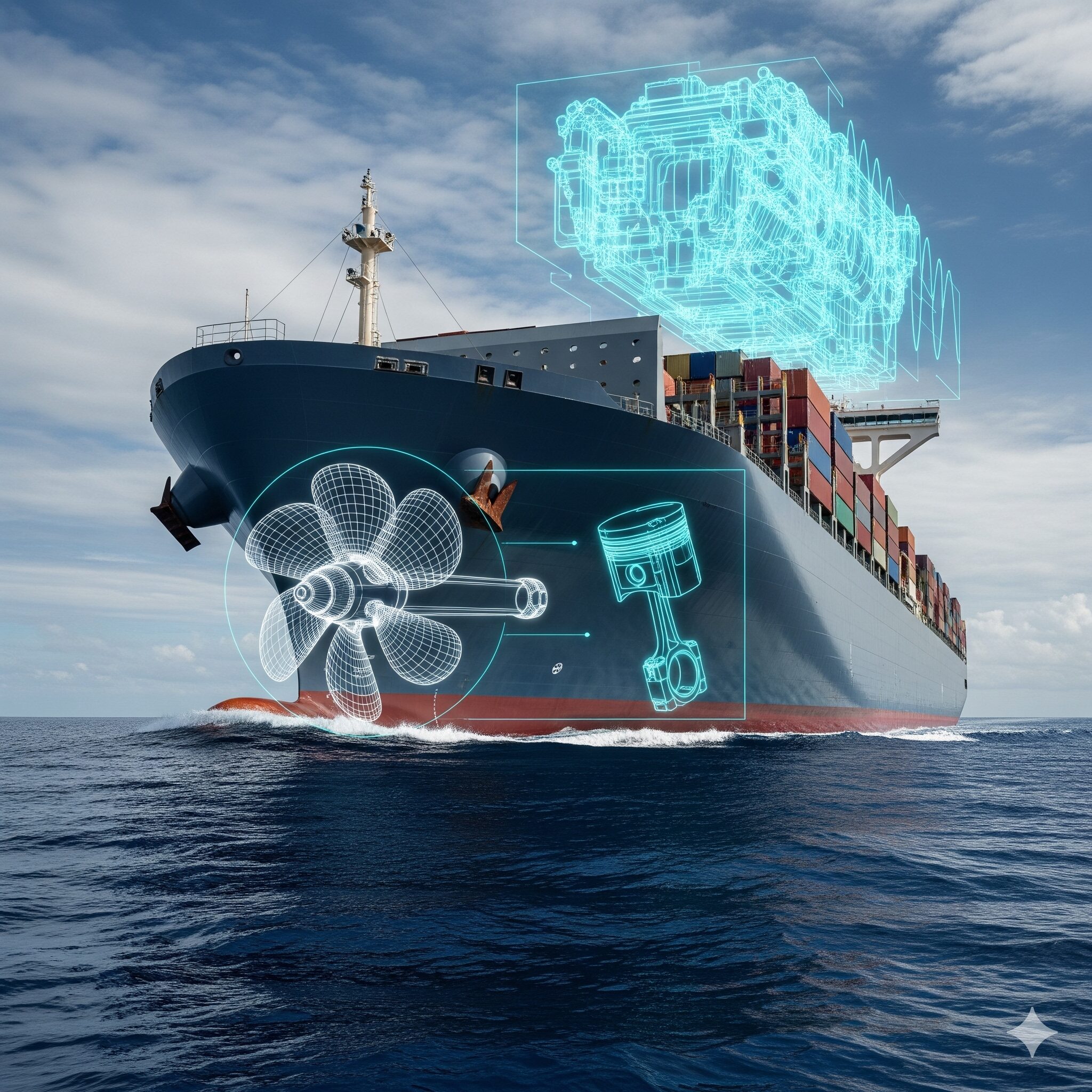
Slow Steaming:
The Solution and The Problem
The "Simple" Solution
Reducing vessel speed is the most effective short-term measure for lowering Greenhouse Gas (GHG) emissions. Based on the Cubic Law of Propulsion, power (and fuel consumption) is proportional to the speed cubed ($P \propto V^3$).
The Mechanical Reality
However, main engines are designed for 75-90% MCR (Maximum Continuous Rating). Operating continuously at Low Load (<40% MCR) or Super Slow Steaming (<10-20% MCR) violates the engine's design parameters, leading to fouling, corrosion, and efficiency losses.
Drawbacks & Dangers: Deep Dive
Extended operation at low RPM alters the thermodynamic and physical conditions inside the engine. Click categories to expand technical details.
- Poor Atomization: At low loads, fuel injection pressure drops. This results in larger fuel droplets that do not mix well with air, leading to incomplete combustion.
- Delayed Ignition: The lower temperature of compressed air (due to lower turbocharger pressure) delays ignition.
- Soot Deposits: The result is heavy soot formation. This soot deposits on:
- Piston ring grooves (restricting movement).
- Exhaust valves (causing "channeling" or leakage).
- Turbocharger nozzle rings (reducing efficiency).
- Economizer/Boiler tubes (Fire risk).
- Smoke: Visible black smoke is often observed during load changes after prolonged slow steaming.
Marine heavy fuel oil contains sulfur. During combustion, this forms SOx. When combined with water vapor, it forms Sulfuric Acid (H2SO4).
- The Mechanism: At high loads, liner temperatures (>200°C) keep the acid in a vapor state, where it is expelled harmlessly. At low loads, liner wall temperatures drop.
- Dew Point: If the liner temperature falls below the acid's "Dew Point" (typically 110-140°C depending on pressure and sulfur content), the acid condenses into liquid on the liner wall.
- Damage: This liquid acid aggressively corrodes the cast iron liner ("Cold Corrosion") and the piston rings, leading to rapid wear rates (up to 10x normal) and potential seizure.
- Lack of Scavenge Air: Turbochargers rely on exhaust gas energy. At low loads, exhaust energy is minimal. The T/C slows down, providing insufficient air pressure for the cylinders.
- Auxiliary Blowers: Electric auxiliary blowers must run continuously to supplement air (typically cutting in below 30-40% load). This increases the ship's electrical demand significantly, offsetting some fuel savings.
- Fouling: Low exhaust velocity causes soot to settle on the turbine blades and nozzle ring. This imbalance can cause severe vibrations if the engine is sped up without cleaning.
- Surge: Operating far from the design point can push the compressor towards the "Surge Line," causing unstable airflow.
- Low Velocity: Exhaust gas velocity drops significantly. Soot particles, instead of being blown out the stack, settle on the tubes of the Exhaust Gas Economizer (EGE).
- Dry Soot: Unlike high-load operation, the soot formed at low load is often "wet" with unburnt fuel condensing, making it sticky.
- Uptake Fire: If the ship increases speed, the increased heat and oxygen can ignite these soot deposits. An EGE fire (Iron Fire) can melt the boiler tubes and is extremely difficult to extinguish (often requiring flooding the uptake).
- Steam Shortage: Low exhaust temperature means the EGE cannot produce enough steam for heating fuel and accommodation. The oil-fired auxiliary boiler must run, consuming additional fuel.
- Loss of Hydrodynamic Film: Piston ring lubrication relies on speed to create an oil wedge (Hydrodynamic Lubrication). At very low RPM, this film breaks down, leading to "Boundary Lubrication" (metal-to-metal contact).
- Crosshead Bearings: Crosshead engines rely on oil pressure to separate the pin from the bearing. Low speed combined with combustion pressure peaks can hamper this separation.
The Efficiency Penalty
Specific Fuel Oil Consumption (SFOC) vs. Engine Load. Note the rise at low load.
Thermal Risk Profile
Exhaust Temperature drop leads to cold corrosion and low steam production.
Resolving the Issues: Mitigation & Retrofits
1. Cylinder Oil Management
Action: Increase feed rate or switch to High BN (Base Number) oil (e.g., BN 100 or 140) when steaming slow.
Solves: Cold Corrosion. High BN neutralizes the condensing sulfuric acid.
2. The "Daily Kick"
Action: Increase engine load to 70-80% for 1 hour every 24 hours (if navigation permits).
Solves: Burns off soft soot deposits in the exhaust system and boiler before they harden or become a fire risk.
3. Jacket Water Heating
Action: Maintain high Jacket Cooling Water temperatures (outlet ~85°C) even at low load. Bypass the fresh water cooler if necessary.
Solves: Keeps liner walls hot to prevent acid condensation (Cold Corrosion).
4. Frequent Inspections
Action: More frequent scavenge port inspections to monitor ring condition and sludge buildup.
Solves: Early detection of poor combustion effects.
1. Slide Fuel Valves
Retrofit: Replace conventional fuel valves with "Slide" type valves that eliminate the sac volume and improve atomization at low pressure.
Effect: Drastic reduction in smoke, soot, and NOx at low loads.
2. Turbocharger Cut-Out
Retrofit: Install valves to isolate one turbocharger (on multi-TC engines).
Effect: Forces all exhaust gas through the remaining TC, spinning it faster. Restores air pressure and reduces need for aux blowers.
3. Variable Injection Timing (VIT/VTI)
Retrofit/Adjustment: Electronically or mechanically adjust injection timing to occur earlier at low loads.
Effect: Maintains higher Peak Combustion Pressure (Pmax), improving thermal efficiency and reducing fuel consumption.
4. Propeller Retrofit
Retrofit: "Propeller Chopping" (reducing diameter) or installing a new high-efficiency propeller designed for the new lower average speed.
Effect: Optimizes the engine load point, allowing the engine to run at a higher (healthier) relative load for the same ship speed.